
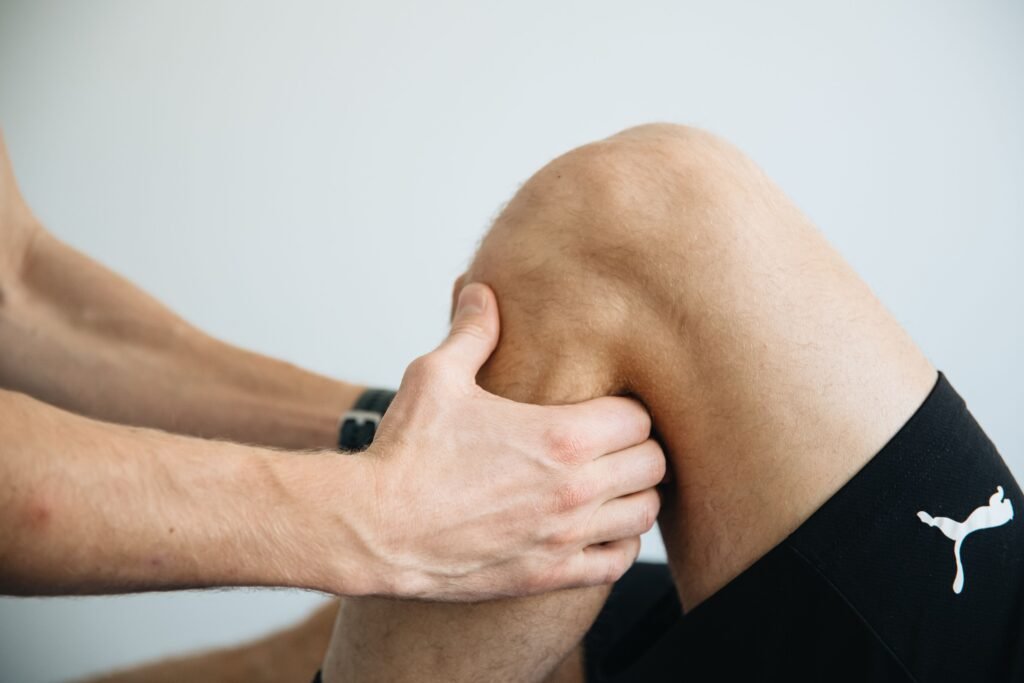
The Secret to Fixing Knee Pain and Unlocking Lower-Body Strength
If you’ve been dealing with nagging knee pain during squats, runs, or even just walking up the stairs, your immediate instinct might be to blame your knees. But more often than not, your knees are just the victims. The real culprit is sitting right above them: a weak gluteus medius.
The gluteus medius is the muscle located on the upper, outer side of your hip. When it gets weak or “sleeps” due to too much sitting, a chain reaction occurs that puts immense pressure on your knee joints.
By shifting your focus to this single, underestimated muscle, you can fix the root cause of your knee pain and unlock a completely new level of lower-body power.
The Kinetic Chain: How Your Hips Control Your Knees
The knee is primarily a hinge joint; it wants to move forward and backward. It does not like to twist or cave inward.
When your gluteus medius is weak, it fails to stabilize your pelvis. Every time you take a step, squat, or land from a jump, your thigh bone (femur) rotates inward, causing your knee to collapse toward your midline. This is known as knee valgus.
[Weak Glute Medius] ➔ [Pelvis Drops/Instability] ➔ [Thigh Rotates Inward] ➔ [Knee Collapses Inward (Valgus)] ➔ [Knee Pain]
This constant inward collapse places massive, uneven stress on the patella (kneecap) and the surrounding tendons. Over time, this leads to common issues like runner’s knee, IT band syndrome, and general joint tracking pain.
The 3-Step Strategy to Wake Up Your Side-Glutes
To protect your knees and build a rock-solid foundation, you need to deliberately target hip abduction (moving your leg away from your body) and external rotation. Add these three highly effective movements to your warm-up or lower-body routine:
1. The Clamshell (Mind-Muscle Connection)
This is the ultimate isolation move to remind a dormant gluteus medius how to fire.
- How to do it: Lie on your side with your hips bent at roughly 45 degrees and your knees bent at 90 degrees. Keeping your feet glued together, raise your top knee as high as you can without tilting your pelvis backward.
- The Secret: Place your hand on your upper, outer glute. You should feel the muscle bunch up and work. Do 2–3 sets of 15 control-focused reps.
2. Supported Single-Leg Romanian Deadlifts (Stability)
By holding onto a wall or rack for balance, you remove the balance challenge and allow the gluteus medius to purely focus on stabilizing the hip.
- How to do it: Stand on one leg next to a wall for light finger-tip support. Hinge at your hips, driving your non-working leg straight back behind you while keeping your hips perfectly level to the floor.
- The Secret: Do not let your standing knee cave inward; actively drive it outward over your pinky toe as you push back up to standing.
3. Lateral Band Walks (Dynamic Strength)
This move forces the muscle to maintain tension while you are moving, which directly transfers to running and lifting mechanics.
- How to do it: Place a loop resistance band around your ankles or just above your knees. Drop into a quarter-squat and take deliberate, controlled steps sideways.
- The Secret: Keep your feet pointing straight ahead. If your toes turn outward, your hip flexors are taking over, stealing the work from your side-glutes.
The Payoff: Better Mechanics, Bigger Lifts
When you fix the tracking of your knee by strengthening the gluteus medius, something incredible happens to your main lifts.
Because your knees are no longer caving inward during a heavy squat or leg press, your body stops putting the brakes on your strength. A stable pelvis creates a rigid, efficient platform, allowing your larger muscles—like the gluteus maximus and quadriceps—to exert maximum force.
The bottom line: Stop treating the symptom (the knee) and start fixing the cause (the hip). Dedicate 10 minutes of your workout to your gluteus medius, and your knees will thank you.
SGPT with Hustle FiSports Direct UK: Sports Shoes, Sportswear & Equipmenttness Belfast. The no1 format for amazing results in the Belfast area